
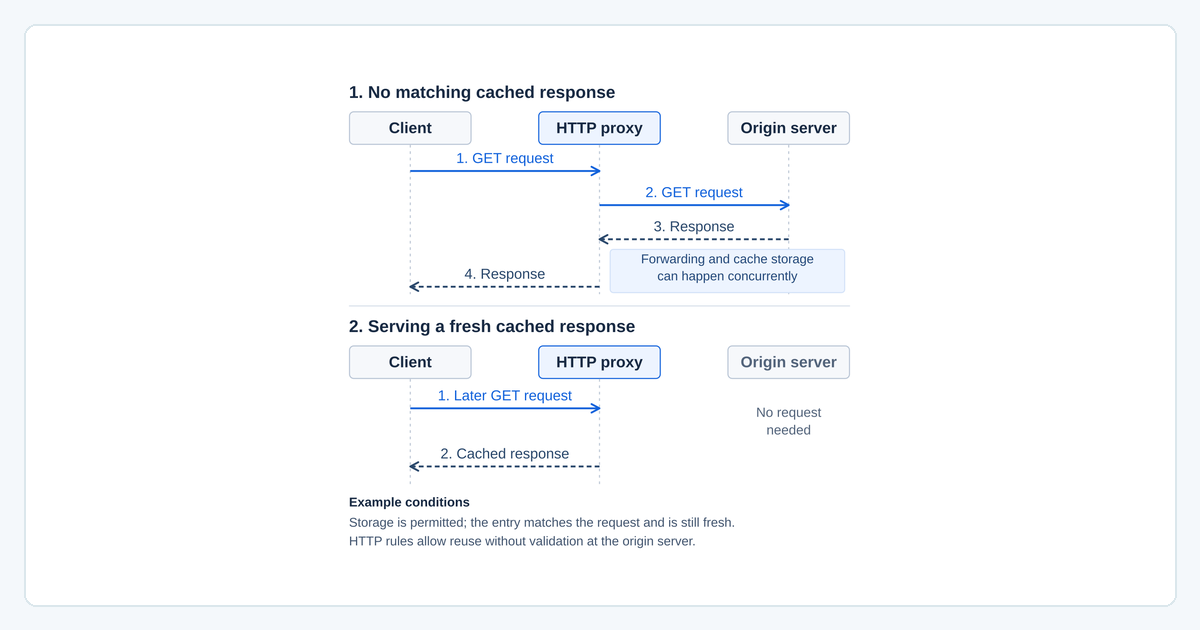

The diagram shows a generic caching proxy; it does not imply that the MooProxy entry provides caching. Client-side conditional requests must be implemented separately.
Measure a comparable baseline
Use the same target, region, session and time window. Record request counts, response codes, body bytes, correct-result rate and your proxy bill. Separate first visits from repeat visits; a 200 response is not proof that the content is correct.
For illustration, downloading a 2 MB response 1,000 times transfers about 2,000 MB in bodies. If 900 validations return 304 without a response body, roughly 1,800 MB of body transfers are avoided. Headers, TLS, retries and billable traffic are additional.
Use ETag and 304 correctly
When a server supplies an ETag, send it in If-None-Match on the next request. A server may respond with 304 Not Modified; reuse the previously stored representation. A 304 is not a replacement for a missing cached body. Last-Modified and If-Modified-Since provide another validation mechanism. Follow the response’s Cache-Control and other directives.
curl -sS -D headers.txt -o response.json https://example.com/data
# Read the returned ETag from headers.txt, preserving its quotes
curl -sS -D recheck-headers.txt -o recheck-body.txt \
  -H 'If-None-Match: "ETAG_FROM_RESPONSE"' https://example.com/data
Use this only for resources you are authorized to access. The example URL is a placeholder. On 304, a real client must load its cached copy; if none exists, fetch a complete response.
Separate accounts, regions and variants
private, no-store, Vary and authentication affect whether a response may be reused. Never share personal account data across users. Keep language, authorization, location, cookies and other content-affecting inputs in the cache boundary. Identical URLs can return different prices in different regions.
For balances, inventory and prices, agree freshness requirements with the data owner. Do not store a response that prohibits storage, and do not use caching to bypass access controls.
Roll out with a measured comparison
- Choose a small set of permitted public resources and record the baseline.
- Enable validation and verify 200/304 content and update delays.
- Compare the proxy bill and track failures, retries and incorrect results.
- Define expiry, invalidation and rollback before expanding.
See also reducing Playwright proxy traffic for browser resource choices.
Sources and editorial notes
Reviewed 2026-10-29. An original guide based on the following sources; examples are illustrative.